


Before Kye Hines, before relatively small centers became popular, there was Mason Rocca. Also in Milan, there was Mason Rocca. Two-meter tall, perhaps less, but a lot of courage, no fear of getting an elbow in the face, not even from Yao Ming, who after a memorable Italy-China game in the 2006 World Cup mimicked the gesture that perhaps he would have liked to implement in the game, annoyed by his presence. Rocca was like that: loyal, generous, combative. Quick to run on the break, faster than his opponents, richer in energy and desire, because it was the only way he had to stand out in a world in which he shouldn’t have had all this success.
Rocca played for the national team, was captain of Olimpia, and is now a member of its Hall of Fame. And when he started playing, he didn’t even know if he would make it past college. For this reason he went to Princeton University, in the Ivy League, a university more suitable for future Nobel Prize winners rather than future athletes. “Studies were Plan A,” he admits. A world opened up to him when he came to Italy for a summer tour. Sidney Johnson explained it all to him: he played in Gorizia but eventually he would also pass through Milan. As Bill Bradley, also a former Princeton graduate, did years earlier. The analogies with Rocca run through the entire Olimpia’s history: he was born in Evanston, on the shores of Lake Michigan, just outside Chicago. Like Dan Peterson who was going to coach him in 2010/11.
When did you deveolp your basketball love?
“My basketball passion was born when I was 8 or 9 years old. Now, the kids start earlier. I played with my friends. I was tall, so playing basketball might have been natural for me, but I really liked it. I played many sports, but basketball more. I liked the dynamism, the fact that you touch the ball a lot. When I grew up, when it was time to choose, I took the path that I liked best.”
However when it was time to pick a college you enrolled at Princeton, became an Ivy leaguer.
“I wasn’t sure about my future in basketball. I always thought it was wise to have a Plan B, but when I went to Princeton it was actually a Plan A. I studied engineering, I was especially good at math. I chose that path, but I knew that Princeton had a strong basketball tradition, too. This combination of factors took me there.”
When did you realize that a professional career was possible?
“After my sophomore year. We came to Italy to do a pre-season tour. A former teammate of mine, Sidney Johnson, was playing in Gorizia, at that time. We played against his team and during those days he showed us what his life was all about. At that moment I realized that everything was beautiful here and the idea of returning one day came up. We also played against Teamsystem Bologna, who had Dominique Wilkins, and there I understood that this is an incredible country and that I would like to experience that life one day.”

You came here straight from college. Being of Italian originis affected your choice?
“Yes. it did. I knew it would be possible eventually to get citizenship. I did some research on my origins and my agent Massimo Rizzo confirmed that, if I found all the documents, I could play as an Italian and maybe make it to the national team. That was a dream that drove me.”
You started from Jesi.
“Jesi was a perfect start to my career. In the first year there were many foreigners, five in second division, seven in the top one. I was the fifth foreigner signed by Jesi, the last to arrive, an unknown quantity. But we made the playoffs, and the level of the competition was good enough. The following year we took a step forward, reaching the semi-final, and in the third year we went to the final against Virtus Bologna and achieved a historical promotion. For me that type of project, with a basic core of players and some additions every year, represented a lesson in how to build a winning team. Afterwards I went to Naples, but I still feel lucky to have been part of a winning project, in a club that wanted to grow in Jesi.”
Over there you became a Jesi citizen.
“I felt comfortable everywhere, but I particularly liked Jesi’s lifestyle. It’s a quiet place, the food is good, I even bought a piece of land in the countryside. During my career we fixed up that house, then my brother came to visit me and now he is still there, because he married a girl from Jesi. It all started by chance: when they proposed Jesi to me, I didn’t even know where it was, it didn’t even seem like an Italian name to me. But I was lucky.”

You spent memorable years in a passionate town like Naples.
“Naples was all beautiful. I arrived when the club was trying to make big steps. The first year I played in the Uleb Cup, my first international experience, then we won the Italian Cup and played in the EuroLeague. The football team was struggling in those years, and we gathered some of their fans. We were lucky, but the passion of the Neapolitans is exceptional. When we won the Italian Cup, so many people came to celebrate, and they still talk about that trophy. This year they called me when they repeated. They brought back so many memories.”
What did ot mean for you playing for the Italian National Team.
“It was the best moment of my career. Representing Italy in a tournament like the World Cup in Japan was exciting. I remember that before the game against the United States, I sang the Italian anthem. My teammates told me that if I was going to play for the national team, I would have to know the anthem. And I learned it. Then the American anthem started, and I had to stay quiet. I had goosebumps. And then playing against Yao Ming, LeBron James was spectacular.”
Speaking about Rocca means speaking about that famous Yao Ming match-up in the 2006 World Cup.
“Before the game, when Recalcati was explaining who had to defend against him, he said that stopping Yao Ming was impossible, but we had to try to contain him by trying to make him… go crazy, not let the ball get to him easily. I tried to run like crazy, forward, backward, forward, backward, to slow him down. Then offensively I tried to punish him a little or, better yet, make him tire by running a lot, on fastbreaks. I managed to do something, then I think he still scored 30 points. Finally, when we exchanged high-fives at the end, he pretended to elbow me in the face. And there is a picture that portrays him in that gesture. It was a really nice memory: playing against the most famous player of the moment, a Chinese man, in Japan, in front of many Chinese fans, was an unforgettable moment.”

How did you manage to overcome your lack of height and weight against oversize opponents?
“Now there is a lot of talk about smallball, even in the NBA for example Golden State uses Draymond Green at the center spot. We were at the beginning of a process of realizing that what you lose in height you make up for in speed. I was trying to use my speed. Definitely, as far as rebounding, competing in the low post I had to use a lot of energy to overcome what I was lacking in height and weight. But on the break, in pick and roll plays, I had advantages that I managed to use in my favor.”
The hook shot was implemented out of necessity?
“Yes, I learned to execute the hook shot when I was at Princeton, because there we had a system that brought the center to the low post, but even there we played against bigger and more athletic teams. So, from day one the big men had to learn the hook. It took time. I didn’t score much with that shot, but I could use it.”
Why did you decide to come to Milan?
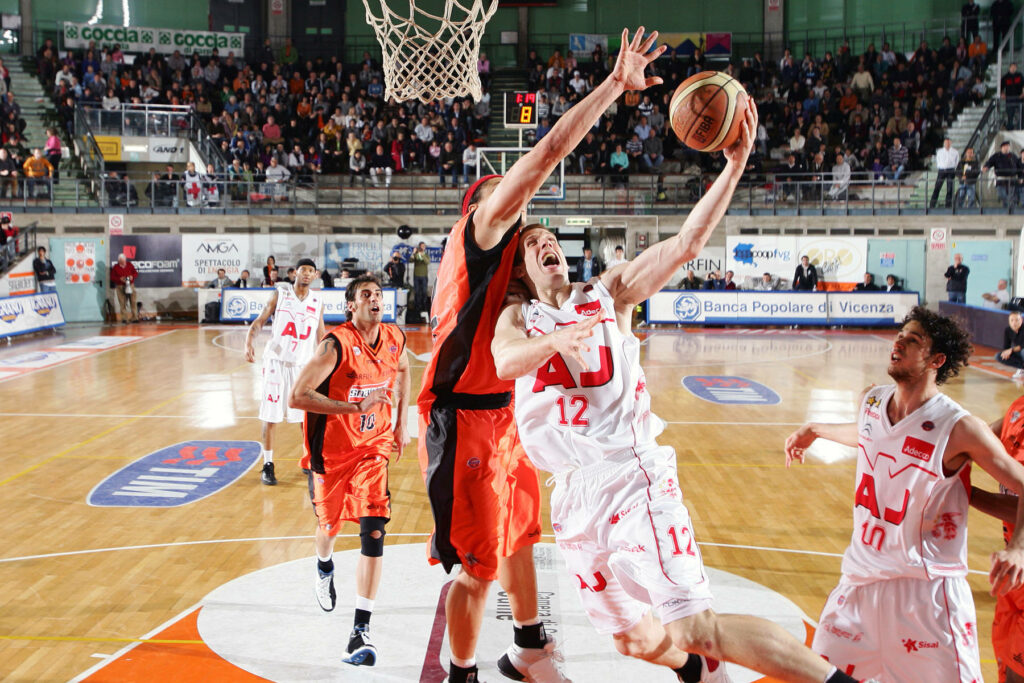
“The club was in a transition phase, but with a personality like Giorgio Armani as the owner I thought they wanted to do something important. I thought there was a possibility of building something significant and I was intrigued. Siena and Roma also wanted me, but I had reached a moment in my career where I wanted to win, go to the top, but be a part of an emerging project in an important place like Milan was stimulating.”
Do you feel like you were part of when the team started to build foundation for its future successes?
“We were at the beginning of the history of this club, there was a lot to build, and every year we made some steps forward. But I think we built the foundation in that period. We recovered the fans. Before Mr. Armani became the owner the fans were a bit lost, there wasn’t the warmth there is now. But we recovered them, we went to the championship series, and we rekindled the fire, the determination to want to win and grow. I am proud to have been part of this project which has led Olimpia to return to being a great club.”
You played along Nicolò Melli, his young version.
“It is not a surprise to me that he had this type of career. He was 20 years old when we played together, but he had talent, determination, desire, and was smart. I played against him in practice, and I had to use all the tricks in my book to contain him, because he played inside and outside, he was strong. I knew he would go places.”
And how it was to be coached by Dan Peterson for a while?
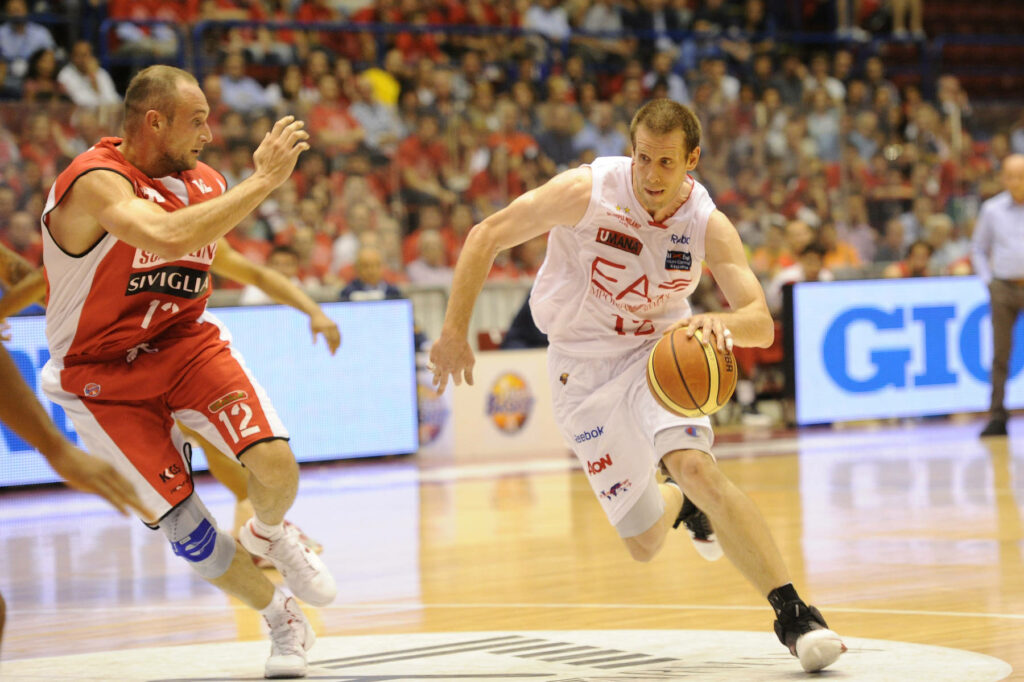
“I didn’t expect it. Piero Bucchi was the coach. Peterson replaced him. Dan and I are from the same town, Evanston. Coach Peterson has done enormous things here in Milan, but certainly an absence from the bench for so many years was weird. The first game we immediately used his historic 1-3-1 zone defense. It was the first time I saw it. We won. The other team didn’t know what to do. The next few times, it didn’t work that well. But every practice Dan told one story. He is a man who has seen everything. He had an incredible wealth of experience. We didn’t get to play well together, fix our problems, but it was fun. I learned a lot from him too.”
You are part of the Olimpia Hall of Fame now.
“It’s a great honor. When I see the list of players who have passed through here, Dino Meneghin, Bill Bradley, many others. My name in this group is surreal. I am proud of the time I spent in Milan. Even if we didn’t win, I was part of a club that made history in Italy and Europe. Coming back here, after returning to the United States, seeing my former teammates, my friends who are doing great things, it’s exciting. I thank Mr. Armani, Ettore Messina for allowing me to join this elected group of people.”

You stayed for many years with the same teams.
“It was my choice. There are players who want bigger contracts, better money, but for me it was more important to feel involved in the city, in the club. I had to feel a sense of belonging, feel involved, make friends with the fans, I wanted the children to go to school in the city. For me it was much more than a job, I wanted to give more than the time spent in practices and games, but I received much more than money back, I received a lot from a cultural point of view, in terms of friendships. I was lucky, but it’s what I wanted.”
Can you tell what are you doing now?
“Since I stopped playing the game, I’ve gone back to studying. I got my master’s degree at Northwestern. I taught high school math and coached my children’s teams. Then they asked me to become principal of my children’s school. I had no experience, but they needed it and I like it. It’s hard, more than playing basketball, but for me education is important, because you take care of the most precious thing that we have, our children. It gives me satisfaction to help teachers, parents and students.”


